
You've seen him everywhere — that cheerful cartoon guy in the blue and yellow jumpsuit, flashing a thumbs up with one eye closed. Vault Boy is more than just a video game mascot. He's become one of gaming's most recognizable symbols, appearing across merchandise, memes, and now streaming on Prime Video. But what does Vault Boy actually represent, and why has this little guy resonated with millions of fans for nearly three decades? We're breaking down everything you need to know about Fallout's famous face.
Key Takeaways
- Vault Boy is the corporate mascot of Vault-Tec Corporation, the company behind the underground vaults in the Fallout universe
- The 2024 Fallout TV show on Prime Video revealed a surprising origin story connecting Vault Boy to the main character Cooper Howard
- His iconic thumbs up pose has sparked a popular fan theory about measuring safe distance from a mushroom cloud — though the original developers deny this was intentional
- Vault Boy appears throughout Fallout games to illustrate perks, skills, and stats on the Pip-Boy interface, often in humorous ways
Shop Our Fallout Collection Now
Who Is Vault Boy?

Vault Boy is the official corporate mascot of Vault-Tec Corporation, the fictional company responsible for building underground vaults designed to protect vault dwellers from nuclear war in the Fallout universe. This young male cartoon character first appeared in the original Fallout video game in 1997, created by artist George Almond.
Vault Boy's signature design includes:
- Blond hair and a cheerful expression
- The iconic blue and yellow jumpsuit
- A thumbs-up pose with one eye closed
- Retro 1950s advertising aesthetic
His appearance echoes the optimistic mascots of 1950s America, fitting perfectly with Fallout's retro-futuristic world. The franchise blends atomic-age optimism with post-apocalyptic horror, and Vault Boy embodies that dark irony — a smiling face representing a company whose vaults often served as sites of horrifying experiments.
Throughout the Fallout games, Vault Boy appears as the visual representation for the player character's abilities, perks, and S.P.E.C.I.A.L. stats. He's essentially the skill guy who shows up to illustrate every gameplay mechanic in humorous ways. Vault Boy was originally called Vault Man in early documentation, and there's also Vault Girl, his female counterpart, who appears with equal frequency in certain games.
The Fallout TV Show's Cooper Howard Revelation
The 2024 Fallout TV show streaming on Prime Video delivered a major revelation about the Vault Boy meaning. In the Fallout series, viewers learn that Vault Boy's appearance is based on Cooper Howard, a famous Hollywood actor played by Walton Goggins.
What the Fallout show reveals about Cooper Howard:
- Cooper was a beloved Western film star before the Great War
- He became the official spokesman for Vault-Tec Corporation
- In the first episode, Cooper Howard gave a thumbs up at a photoshoot created the Vault Boy image
- Howard explains his genuine belief that Vault-Tec would save humanity
- Cooper eventually discovers Vault-Tec's role in orchestrating nuclear devastation
This origin story adds profound tragedy to the character. Cooper Howard becomes the Ghoul — a disfigured, centuries-old bounty hunter — after the bombs drop. Now, every cartoon Vault Boy image represents the face of a man who would eventually curse the company he represented.
Why Does Vault Boy Give a Thumbs Up?
The most enduring mystery surrounding Vault Boy's thumbs-up has generated one of gaming's most popular fan theories. According to this idea, Vault Boy is demonstrating how to measure safe distance from a nuclear blast — if a mushroom cloud from a big bomb is larger than your thumb at arm's length, you're within the radiation zone.
What the original developers say:
- Brian Fargo stated that Vault Boy "simply has a positive attitude"
- Artist Tramell Ray Isaac confirmed the pose "has nothing to do with measuring the cloud"
- The U.S. Department of Energy clarifiedthat the thumb rule itself is a myth
What the Fallout TV show changed:
- Training films in the show depict cartoon Vault Boy demonstrating the measurement technique
- The fan theory became official canon through the Fallout show
- Howard explains Vault-Tec's propaganda throughout the series
So while the original video game creators never intended this meaning, the Fallout show embraced the popular interpretation and made it official lore when the bombs drop.
Shop Our Fallout Collection Now
Vault Boy vs. Pip-Boy: Understanding the Difference
One common mistake among casual Fallout fans is confusing Vault Boy with Pip-Boy. Here's the key difference:
|
|
Vault Boy |
Pip-Boy |
|---|---|---|
|
What it is |
Cartoon mascot character |
Wrist-mounted computer device |
|
Appearance |
Blond hair, blue and yellow jumpsuit |
Electronic device with a screen |
|
Represents |
Vault-Tec Corporation |
RobCo Industries technology |
|
Function |
Illustrates perks, stats, and propaganda |
Manages inventory, maps, and stats |
The Pip-Boy interface displays Vault Boy as its visual mascot, which causes confusion. This error has historical roots — when Micro Forté developed Fallout Tactics, they mistakenly labeled Vault Boy as "Pip-Boy." Even veteran writer Chris Avellone initially used the wrong name.
The Pip-Boy also has its own distinct mascot, a red-haired figure in a red-and-yellow jumpsuit, associated with RobCo Industries rather than Vault-Tec Corporation.
The Symbolic Meaning Behind Vault Boy

Beyond his role as a corporate mascot, Vault Boy carries deeper thematic significance within the Fallout universe.
What Vault Boy symbolizes:
- False optimism — His smile represents pre-war America's dangerous confidence about nuclear war
- Corporate evil — Vault-Tec promised protection while conducting twisted experiments on vault dwellers
- Dark humor — Vault Boy appears in violent situations with one eye closed, still giving a thumbs up
- 1950s satire — He parodies advertising culture, echoing Rich Uncle Pennybags from the Monopoly board game
When illustrating perks and skills, Vault Boy maintains his cheerful pose through facial expressions depicting radiation exposure, dismemberment, and other horrors. This absurdist comedy captures Fallout's tone perfectly.
For collectors, understanding Vault Boy's meaning transforms merchandise into engagement with sophisticated satire. That Fallout Vault Boy Thumbs-Up 3-Inch Mini Figure represents gaming's most effective critique of corporate propaganda.
Vault Boy's Evolution Across the Fallout Series
Vault Boy has appeared in every mainline Fallout game since 1997, with his role expanding significantly over time:
- Fallout (1997) — George Almond created the initial concept; Tramell Ray Isaac finalized the iconic look
- Fallout 2 & New Vegas — Vault Boy appears throughout the Pip-Boy interface, illustrating perks and stats
- Fallout 3 & 4 — Collectible bobbleheads scattered throughout the game world boost player stats when found
-
Fallout TV Show (2024) — The Fallout show on Prime Video reveals his origin story through Cooper Howard
These in-game bobbleheads were canonically produced as executive merchandise by Vault-Tec Corporation and given to winners of the vault acceptance lottery. The character has become the face of the entire Fallout franchise, appearing on everything from figures to apparel to home decor.
Collecting Vault Boy Merchandise
For fans looking to bring Vault Boy into their homes, official licensed merchandise features accurate blue and yellow coloring and proper Vault-Tec branding. Here are some top picks for vault dwellers:
Figures and Collectibles:
- Fallout Vault Boy Thumbs-Up 3-Inch Mini Figure — The iconic pose in collectible form
- Fallout 3-Inch Mini Figure Collection | Complete Set of 12 — Twelve different Vault Boy poses
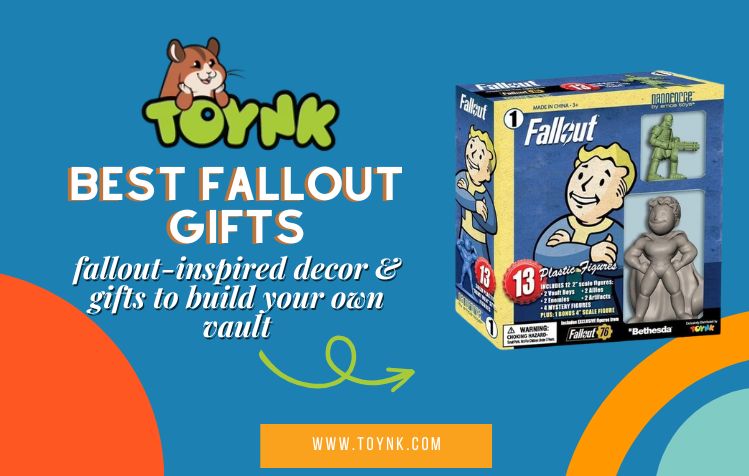
- Fallout Nanoforce Series 1 Army Builder Figure Collection — Army-men style figures featuring various perks
Games and Puzzles:
- Fallout Periodic Table of Vault Boy 1000-Piece Jigsaw Puzzle — Exclusive puzzle displaying dozens of perk poses
- Fallout Vault Boy Playing Cards — 52-card deck depicting various perks from the video game
Everyday Items:
-
Fallout Coffee Mug — Holds approximately 20 ounces with a 3D sculpted Vault Boy design
FAQs
Why does the Vault Boy do a thumbs up?
Vault Boy's thumbs-up originally represented simple optimism and a positive attitude, according to the character's creators. Developer Brian Fargo confirmed Vault Boy "simply has a positive attitude." However, the Fallout TV show canonized a popular fan theory that he's demonstrating how to measure safe distance from a nuclear blast by comparing your thumb to the mushroom cloud size. The show depicts Cooper Howard posing for a Vault-Tec promotional shoot.
Is Vault Boy the Ghoul?
Not exactly, but there's a connection. The Fallout show reveals that Vault Boy's image is based on Cooper Howard, a pre-war actor who became Vault-Tec's spokesman. Cooper Howard eventually becomes the Ghoul — a disfigured, centuries-old survivor played by Walton Goggins. So while Vault Boy, the mascot, and the Ghoul are different entities, the man whose likeness inspired the cartoon Vault Boy image is indeed the same person who becomes the Ghoul after the bombs drop.
What is the difference between Vault Boy and Pip-Boy?
Vault Boy is the cartoon mascot with blond hair and a blue-and-yellow jumpsuit who represents Vault-Tec Corporation. Pip-Boy is the wrist-mounted computer device that Vault Dwellers use in the games. Vault Boy appears as the visual mascot on the Pip-Boy interface, which can cause confusion, but they're distinct entities within the Fallout universe.
When did Vault Boy first appear?
Vault Boy first appeared in the original Fallout video game released in 1997. Artist George Almond created the initial concept under the direction of designer Leonard Boyarsky, with Tramell Ray Isaac finalizing the iconic look fans recognize today.
Conclusion
From corporate mascot to cultural icon, Vault Boy has evolved far beyond his origins as a simple cartoon character illustrating video game perks. The Fallout TV show's revelation linking him to Cooper Howard adds emotional depth to every thumbs-up and wink, while his satirical edge continues to resonate with fans who appreciate the Fallout franchise's dark humor. Whether you're a longtime wasteland wanderer or new to the series thanks to Prime Video, understanding Vault Boy meaning enriches your appreciation for one of gaming's most thoughtfully designed characters.
Explore our Fallout collection to find officially licensed merchandise featuring everyone's favorite vault mascot.
Shop Our Fallout Collection Now
Citations:
[1] https://time.com/4458554/best-video-game-characters/