
Grand Champion horses were discontinued after Empire Toys went bankrupt in 2000 and Alpha International stopped production by 2007. This covers the full brand history — from the late '80s debut through the '90s peak to the final fade. For nostalgia collectors, horse figurine fans, and anyone who grew up brushing those manes, understanding what happened helps you identify, value, and collect them today.
Key Takeaways
- Grand Champions were produced from 1988 to 2008 by Empire Toys and later Alpha International, spanning a 20-year run before the line was discontinued.
- Empire Toys declared bankruptcy in 2000 due to rising competition and shifting market trends, nearly ending the brand for good.
- Alpha International acquired the Grand Champions brand in 2001 but put the line on indefinite hiatus by 2007.
- Loose figures in played-with condition typically sell in the single digits on resale platforms, while new-in-box sets and rare variants can reach well over $100.
- Vintage figures are helping drive growth in the collectibles market, which is expected to increase from $321 billion in 2025 to $467 billion by 2032.
- Collectors looking for Grand Champions model horses can still find select figures and sets through our Grand Champions collection.
Shop The Grand Champions Collection Here
What Really Happens to Grand Champion Horses?

The short answer: Grand Champions are no longer in production. The brand went through two owners, two near-death experiences, and a slow fade that ended around 2008.
But that does not mean they are gone. A passionate collector community keeps the brand alive through resale markets, fan-maintained identification websites, and social media nostalgia content. Collectors also share photos of their collections across dedicated fan communities. According to the Grand Champions Wiki, the figures were produced between 1988 and 2008 across two companies and multiple product lines.
How Did Grand Champions Model Horses Get Their Start?
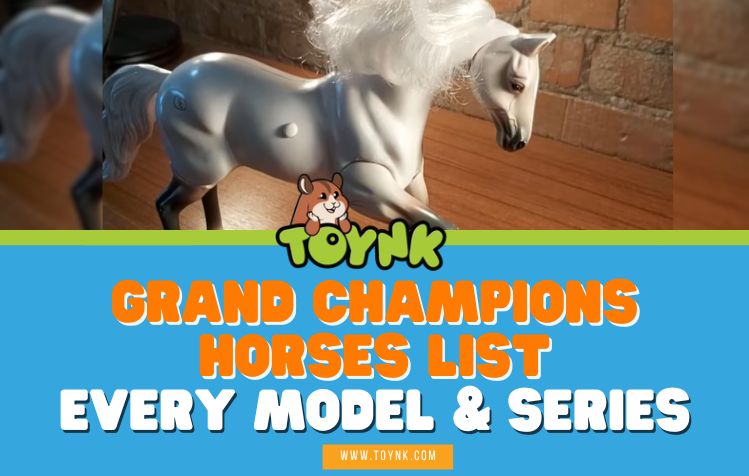
Grand Champions debuted in the late 1980s as a toy horse line under Empire Toys, with early manufacturing handled by Marchon Industries. The figures stood approximately 6 inches tall — 6-inch models roughly the same scale as Breyer Classic models — and were made from hard plastic with soft, brushable manes and tails. They came in a wide variety of styles, colors, and poses, with each release representing a different real-world breed.
What set them apart from competitors was their attention to breed accuracy. Each horse came with a biography card detailing the figure's name, breed, and backstory. That biographical element gave each figure a personality and turned casual buyers into collectors.
Early models carry a Marchon Industries stamp on the inside leg. Later Empire-era figures are stamped "Empire." Knowing these markings is one of the easiest ways to identify which era a Grand Champion horse belongs to.
What Made the Grand Champion Line Expand in the '90s?
The 1990s were the golden age for Grand Champions. Empire Toys expanded the line far beyond standard stallions and mares, introducing new stallions, mares, and foal figures that pushed the brand into new territory.
The major expansions included:
- Sound 'n' Action stallions — featured buttons that played realistic horse sounds.
- Motion horses — could rear and kick with mechanical action.
- Feed 'n' Nuzzle line — jointed heads with magnetic muzzles that let figures interact with accessories and each other.
- Mini horses — scaled-down stallion and foal figures at Breyer Stablemate size for smaller collections
- Micro Minis — even smaller pocket-sized toy figures
- Fantasy Fillies — unicorns and pegasi built on familiar Grand Champion molds, some with flapping wings, crystal horns, or built-in lights
Fantasy Fillies were produced for a brief window in the mid-to-late '90s and are now among the harder-to-find pieces in the line. Family sets featuring a stallion, mare, and foal were especially popular with collectors year after year.
At their peak, these model horses were widely available across North America, the UK, Europe, and Australia. Each set came bundled with tack, grooming supplies, and sometimes even foal and rider figures.
Why Did Grand Champions Disappear the First Time?
In the year 2000, Empire Toys declared bankruptcy. The exact reasons were never publicly detailed, but collectors point to rising competition from Breyer, shifting retail distribution, and the broader challenges small- to mid-tier toy manufacturers faced as big-box stores consolidated shelf space.
Overnight, Grand Champions vanished from store shelves across Australia, Europe, and most of Canada. In the U.S., only scattered old stock remained.
What Happened to Grand Champions After 2008?

The story did not end with the Empire's bankruptcy. The following year, in June 2001, Alpha International of Cedar Rapids, Iowa, acquired the brand. They partnered with Mutiny Bay Enterprises for online sales and vowed to continue the line.
For a few years, Alpha delivered new releases year after year. New models entered the market, and the Blue Ribbon Program gave collectors a direct purchasing channel. But the momentum did not last.
But by the mid-2000s, Alpha International began releasing figures under the "Horse Country" label — and collectors noticed a drop in quality. Fan communities have been blunt about this era, with one prominent collector site going so far as to say they "ignored the horrendous Horse Country-era horses." The sculpt detail, paint quality, and overall craftsmanship that defined the original Empire-era figures had declined.
In the spring of 2007, Alpha International went on indefinite hiatus. Production stopped entirely. By 2008, no new model horses were being made, and the toy line effectively became a collectors-only market.
Shop The Grand Champions Collection Here
Why Did Grand Champions Decline?
Multiple factors contributed to the brand's fade:
- Breyer's dominance — Breyer had a much larger collector community, more sophisticated retail distribution, and a well-established show circuit that kept demand steady
- Ownership instability — the transition from Empire to Alpha introduced inconsistency in product quality and brand direction
- The Horse Country misstep — quality shifts under the Horse Country label frustrated loyal collectors and eroded trust
- No collector infrastructure — unlike Breyer, Grand Champions never established standardized grading or an organized community structure that could sustain secondary market interest
Did Grand Champions Come Back?
Not in the traditional sense. No company has relaunched the Grand Champion line with new molds or production runs. The molds appear to be shelved, and there has been no public announcement about a revival.
However, the brand's nostalgia factor remains powerful. Vintage Grand Champion commercials regularly go viral on social media, with some nostalgia videos earning over 32,000 likes and hundreds of comments. The emotional connection '90s collectors feel toward these figures is real — and growing as that generation enters peak collecting age.
How Do Grand Champions Compare to Breyer?
Here is how the two lines stack up:
|
Feature |
Grand Champion Horses |
Breyer Models |
|---|---|---|
|
Scale |
Approximately 6 inches (Classic size) |
Multiple scales (Stablemate, Classic, Traditional) |
|
Material |
Hard plastic with brushable manes and tails |
Cellulose acetate or vinyl (no brushable hair on most models) |
|
Interactivity |
Sound, motion, nuzzling features on some lines |
Static display models |
|
Price point (original retail) |
Lower, more accessible |
Higher, especially Traditional scale |
|
Collector community |
Smaller, fan-maintained |
Large, organized with shows and events |
|
Current production |
Discontinued |
Still actively produced |
Breyer models lean toward display collecting, while Grand Champions leaned into playability with brushable hair and interactive features. Many collectors loved both lines for different reasons.
What Happened to the Horse Figurine Hobby Since Then?

The horse figurine hobby has actually grown. According to Stellar Market Research, the global collectibles market is projected to reach $467 billion by 2032, up from $321 billion in 2025. The vintage collectibles segment accounted for over 42% of market revenue, and figures are the fastest-growing category, with a projected 7.11% compound annual growth rate.
Modern horse figure brands continue to serve collectors who want breed-accurate, hand-painted figures at various scales:
- Breyer CollectA — hand-crafted vinyl figures sculpted by noted equine sculptor Deborah McDermott
- Schleich — German-made, approximately 1:19 scale, widely available
- Safari Ltd — realistic detailing with educational focus
- Papo — French-made figures known for dynamic poses
For fans who grew up with Grand Champions, these brands offer a way to keep the hobby going.
We carry a selection of Grand Champions figures for collectors looking to revisit the brand, as well as Breyer CollectA models for those exploring modern alternatives.
How Do You Identify and Preserve Grand Champion Horse Models?
Identification starts with the manufacturer's stamp. Here is how to date a Grand Champion horse by its markings:
- Marchon Industries stamp (inside leg) — earliest production era, late '80s to early '90s
- Empire stamp (inside leg) — mid-'90s peak era
- Alpha International markings — post-2001 production
- "GC" logo on the rump — another identifier, but it tends to rub off over time. If the logo is worn, check reference photos online or use the leg stamp as a more reliable method.
For preservation, follow these best practices:
- Store figures out of direct sunlight to help prevent yellowing and preserve the plastic.
- Store brushable manes and tails untangled to avoid permanent kinking.
- Use warm water and a gentle comb to restore tangled hair.
- Try hydrogen peroxide treatments (sometimes called "retrobright") to reverse yellowed plastic, though this requires careful handling to avoid surface damage.
- Keep accessories together — complete sets with original tack, biography cards, and packaging command significantly higher resale value.
FAQs
What happens to real champion horses after they retire from competition?
The fate of a real grand champion horse depends largely on its gender, pedigree, and discipline. Stallions with exceptional bloodlines are often retired early to breeding farms — particularly in Kentucky's Bluegrass region — where they are highly sought after for stud. Champion mares generally retire to become broodmares, producing the next generation of competitors.
For geldings and non-breeding mares, retirement paths include:
- Equine sanctuaries and nonprofit organizations that provide dignified lifetime care, including specialized diets, joint supplements, and therapies
- Private farm retirement, where many horses return to their owner's property for peaceful pasture turnout
- Retraining programs that help champion horses get retrained for other equestrian disciplines — many excel as show jumpers, dressage partners, eventers, or trail riders.
- Teaching roles, where experienced champions help younger athletes develop advanced riding skills, or owners lease them to less experienced riders for lower-level competitions
- Ambassador roles, where non-breeding horses live as beloved resident ambassadors at public facilities, serve as brand ambassadors or make public appearances.
The equine industry relies on accredited aftercare networks to rehome and care for retired horses. Organizations like the Thoroughbred Aftercare Alliance ensure safe rehabilitation and adoption of off-track horses, and programs like the Retired Racehorse Project showcase the versatility of ex-racehorses. Specialized retirement farms also provide dedicated, round-the-clock equine care.
What breeds were available in the Grand Champion Horse line?
The Grand Champions line covered a wide range of real breeds, including Quarter Horses, Arabians, Thoroughbreds, Morgans, Tennessee Walkers, Saddlebreds, Clydesdales, Warmbloods, and Appaloosas. Most breeds were available as stallion, mare, and foal sets. The line also included fantasy variants like unicorns and pegasi under the Fantasy Fillies label.
How much are Grand Champion Horses worth today?
Values vary widely based on condition and completeness. Loose toy horse figures in played-with condition typically sell for under $10 on resale platforms. New-in-box sets, complete family sets with original accessories, and rare variants like Fantasy Fillies can sell for $50 to over $180. The secondary market has shifted upward year over year as '90s nostalgia collecting has grown.
What are the best alternatives to Grand Champions today?
For collectors who loved the scale and breed accuracy of Grand Champions, the closest modern options include Breyer CollectA (hand-crafted vinyl figures at a similar 1:18 scale), Schleich (German-made, approximately 1:19 scale), and Safari Ltd. We carry a variety of horse figurines in our Grand Champions collection, and you can save more when you bundle multiple figures through our Buy More Save More program.
On a Final Note
Grand Champion horses may no longer be rolling off the production line, but their impact on a generation of collectors is permanent. From the brushable manes to the breed biography cards, these figures offered something no other line quite matched. The market for vintage figures continues to grow, and new horse figurine brands are driving the hobby forward.
Browse our website's Grand Champions collection to find figures from this beloved line, and check out our Buy More Save More deals to get the most out of your collection.
Shop The Grand Champions Collection Here