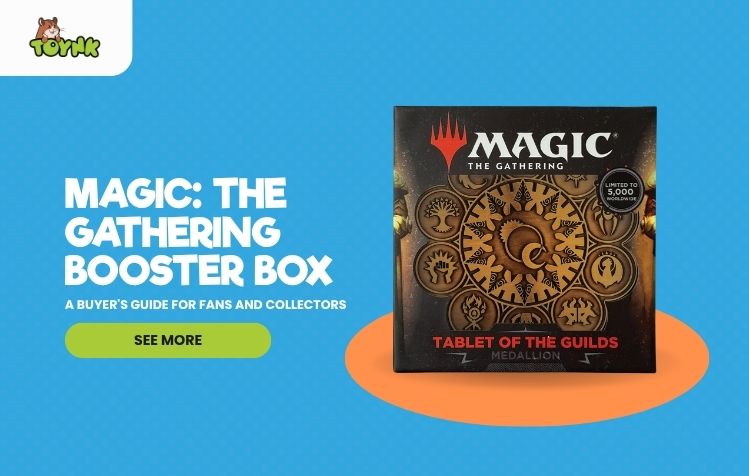

Magic: The Gathering can look intimidating at first — strange symbols, five colors, and a deck full of spells. But it clicks fast, and it is a blast once it does. We put together everything a new fan needs to understand the game and start playing today.
Key Takeaways
- First released in 1993, Magic: The Gathering introduced the trading card game format and remains one of the world’s most popular, with tens of millions of players.
- You play as a planeswalker, casting spells and summoning creatures to drop your opponent's life total from 20 to 0.
- Five colors of mana — white, blue, black, red, and green — shape how every deck plays.
- Commander is the most popular way to play today, and it is one of the friendliest formats for new players.
- You can start cheap. A beginner box or preconstructed deck costs about the same as a video game.
- A few rare cards, like the Black Lotus, sell for tens of thousands of dollars.
Shop The Magic the Gathering Collection Here
What Is Magic: The Gathering?

Often shortened to MTG, Magic: The Gathering is a trading card game where players face off using decks made from collectible cards. Mathematician Richard Garfield created it, and Wizards of the Coast released it in 1993. It was the first trading card game and set the pattern that nearly every card game after it would follow.
In the story of Magic, you are a planeswalker. That means you are a powerful wizard who can travel between different worlds, called planes. Each card in your deck is a spell you cast to win the duel. New card sets, called expansions, come out throughout the year, and each one tells an ongoing story set on a new world.
Magic also has deep lore. Its many stories feature iconic characters, from heroic planeswalkers to fearsome villains, whose adventures play out across countless worlds.
The game has grown into something huge. Magic has reached tens of millions of players worldwide, and it is one of Hasbro's biggest brands. Players are a mixed crowd. The average tabletop player is about 30 years old, and most range from 13 to 45, according to Hasbro.
Here is a fun detail for anyone worried they are late to the party. Player experience splits almost evenly into thirds. One-third have played for under 3 years, one-third for up to 10 years, and one-third for 10 years or more. New players join every single day.
How Does Magic: The Gathering Work?
At its heart, Magic is simple—two or more players battle as planeswalkers, each starting with 20 life. The goal is to reduce your opponent's life to 0 before they do the same to you.
You do this over a series of turns, and each turn follows the same set of phases. On your turn, you can:
- Play a land to make mana, the resource that powers your spells.
- Cast creatures and other spells, each with a mana cost you have to pay
- Attack with your creatures to deal damage to your opponent

Lands are the engine of your deck. Most spells cost mana, and mana comes from lands. Play too few lands, and you get stuck. Play too many, and you draw nothing exciting. That balance is a big part of the strategy.
Combat is where games are won. You declare which creatures attack, your opponent declares which creatures block, and then damage is dealt. Any attacker that gets through lowers your opponent's life total. Many creatures also come with their own unique abilities that trigger during play. These gameplay mechanics are easy to learn but tricky to master.
Tracking your life total is part of every game, so many players like a sturdy tool for the job. Our metal life counter collectible is a fun way to keep score during a match instead of scribbling on paper.
While dropping your opponent to 0 life is the main way to win, it is not the only one. Some decks win by making you run out of cards to draw. Others use specific cards with their own victory rules. These alternate win conditions keep the game fresh even after years of play.
What Are the Five Colors of Mana in Magic: The Gathering?
Every card in Magic belongs to one or more of five colors. Each color has its own feel, strengths, and playstyle. Learning the colors is the fastest way to understand the game.
|
Color |
Theme |
How It Plays |
|---|---|---|
|
White |
Order, justice, and community |
Small creatures, healing, teamwork, and steady defense |
|
Blue |
Knowledge, intelligence, and manipulation |
Card draw, countering spells, and outsmarting the opponent |
|
Black |
Power at any cost |
Sacrifice, raising the dead, and draining life |
|
Red |
Emotion, chaos, and freedom |
Fast attacks, direct damage, and aggressive creatures |
|
Green |
Nature, growth, and life |
Big creatures, extra mana, and raw power |
Most beginners start with one color to keep things simple. Once you get the hang of it, you can mix two or more colors for deeper strategy. Just remember that a two-color deck needs the right lands to cast both.
The colors also connect to the game's famous planeswalkers. Chandra is a fiery red mage who loves to burn things down, and our Chandra coin replica celebrates her pyromancer spirit. Jace is a cool blue mind mage who bends the game to his will, shown off on our Jace, the Mind Sculptor throw blanket. Fans of white magic may prefer The Wandering Emperor, whose art appears on our Wandering Emperor throw blanket, measuring approximately 45 x 60 inches.
Shop The Magic the Gathering Collection Here
What Are the Different Ways to Play Magic: The Gathering?
Magic has many ways to play, and they fall into two big groups: constructed and limited.
Constructed means players build a deck ahead of time from cards they own. Limited means you build a deck on the spot from a fresh pool of random cards. Limited is a great equalizer because everyone starts from scratch. Its two main styles are Draft, where players open a pack and pick cards one at a time before passing it along, and Sealed, where each player builds a deck from a set number of booster packs.
Within constructed play, several popular formats exist. Here are the ones you will hear about most:
|
Format |
What It Is |
Good For |
|---|---|---|
|
Commander |
100-card decks with no duplicates, led by a legendary creature |
Casual, social games |
|
Standard |
Decks built from the most recent sets, which rotate over time |
Fresh, ever-changing play |
|
Modern |
A larger pool of cards from 2003 onward |
Deep, competitive play |
|
Draft |
Players open booster packs and build a deck live |
Beginners and one-off fun |
The Commander format is the star of the show right now. Each player picks a legendary creature to lead a 100-card deck where every card is unique. You also start at 40 life instead of 20, so games run longer and get wild. It is casual, social, and welcoming, which is why so many groups play it. It can feel like a lot at first, since there are thousands of possible leaders to choose from, but preconstructed Commander decks solve that problem for you. That makes it a great format for new players.
How Do You Start Playing It?

Getting started is easier than it looks. You do not need a giant collection or a big budget to jump in. Here is a simple path.
- Grab a beginner box or preconstructed deck. These come ready to play, with a balanced set of cards and clear instructions. They cost about the same as a new video game.
- Start with one color to keep your first games clean and simple. You can branch out later.
- Learn with a friend. Playing head-to-head is the fastest way to pick up the rules.
- Try a prerelease event. These sealed events welcome new players, level the field, and often come with friendly help from veterans.
The biggest beginner mistake is buying single cards blind before you understand the game. Skip that. Start with a ready-made deck, play a few rounds, and figure out what you enjoy before spending more. Once you are hooked, a deck box helps protect your cards, and your local game store is a great place to grow your collection.
Where To Play?
You can jump into a game of Magic almost anywhere, from your kitchen table to a phone screen to a game shop full of fellow fans. Here are the three main options.
MTG Arena
MTG Arena is a free-to-play online platform, released in 2018. It runs on your computer or phone, and it teaches the rules through a built-in tutorial. It is a low-cost way to learn because you don't need to buy physical cards to start. Some players feel the in-app economy gets pricey once you dig in, but for learning the basics, it is hard to beat free.
Magic: The Gathering Online is another option, an older platform that lets you trade cards and play in a digital space. Arena is the more beginner-friendly of the two.
At the Kitchen Table
The classic way to play is in person with friends, often called kitchen-table Magic. Grab two preconstructed decks, sit down, and go. There are no rankings and no pressure — just you, your friends, and a stack of cards. This relaxed setting is where most people fall in love with the game.
Local Game Store
Your local game store is the beating heart of the Magic community. Many stores host Friday Night Magic, a casual weekly event that is perfect for meeting other players and trying new formats. You can find a shop near you with Wizards' official Event Locator.
It is a great place to learn from regulars and try formats like Commander or Draft with a real group. Online community groups and forums can also help you connect with other players and improve your game.
What Makes Magic: The Gathering Cards Valuable?
Not all Magic cards are worth pocket change. Some sell for the price of a car. Card values come down to three things: rarity, demand, and history.

The biggest driver is the Reserved List. This group of 572 older cards is one that Wizards of the Coast has promised never to reprint, a policy first set in 1996 to protect collectors, per the MTG Wiki. Because no new copies will ever be made, these cards only get rarer over time.
The most famous is the Black Lotus. This tiny artifact from 1993 is the crown jewel of Magic collecting, and top copies have sold for tens of thousands of dollars. It belongs to a group of super-powerful early cards known as the Power 9. Collectors trade these on a busy secondary market, where prices range from a few cents to millions of dollars, as Wikipedia notes.
For fans who love that iconic art but not the eye-watering price, we offer a cozier tribute. Our Black Lotus throw blanket features the original illustration by Christopher Rush, and our Black Lotus enamel pin set lets you wear a piece of Magic history.
A newer force in the market is crossover sets. Magic now teams up with outside franchises through its Universes Beyond line. The Final Fantasy set became the best-selling Magic release ever, and other crossovers with Marvel's Spider-Man and Avatar: The Last Airbender have drawn huge crowds of new collectors, as covered by Misprint.
Beyond the cards, dedicated collectors love limited replicas of in-game items. Our Avacyn's Moonsilver Spear replica is a silver-plated miniature of the weapon carried by Avacyn, the archangel who protects the world of Innistrad. It is limited to 1,993 pieces worldwide, a nod to the year Magic began.
Frequently Asked Questions
Is Magic: The Gathering Hard to Learn?
The core rules are easy to pick up in a single game. You play lands, cast spells, and attack to lower your opponent's life to 0. The depth comes later, as you learn card combos and deck building. A beginner box or a quick round on MTG Arena will teach you the basics in about 20 minutes.
How Much Does It Cost to Play Magic: The Gathering?
You can start for the price of a video game with a single preconstructed deck or beginner box. Casual players often spend under $500 in their first year, while more active players spend around $1,100 a year once they draft weekly and chase new sets, according to Cardboard Keeper. The good news is that you control the pace and the spend.
What Is the Best Magic: The Gathering Format for Beginners?
Commander is a great starting point for most new players. It is casual, social, and built for group games with friends. Preconstructed Commander decks give you a strong, ready-to-play option with no deck building required. Draft is another beginner favorite, since everyone opens fresh packs and starts on equal footing.
Conclusion
With a long history spanning over 30 years, Magic: The Gathering is one of the most beloved card games in the world, and it is easier to join than ever. Learn the five colors, grab a beginner deck, and play a few rounds to find your style. Whether you want to duel at your local game store or show your MTG fandom at home, there is a place for you here. Explore our full Magic: The Gathering collection for blankets, pins, coins, and more, and check out our buy more, save more deals when you are ready to stock up.
Shop The Magic the Gathering Collection Here